Call center AI software is reshaping the way businesses talk to their customers. Instead of long wait times, repetitive questions, and overwhelmed agents, 콜센터 AI 소프트웨어 - call center AI software help you deliver fast, personalized support at scale. Leveraging ai call center solutions omnichannel and virtual agent assist technology for customer support, these systems streamline interactions across channels, reduce agent workload, and ensure consistent customer experiences. The result: happier customers, more productive teams, and a call center that becomes a true growth engine for your business.
In today’s fast-evolving business environment, staying ahead requires leveraging the latest cutting-edge technology trends for modern customer service systems. Advanced tools such as high-performance AI processing using supercomputers for enterprise solutions enable call centers to analyze vast amounts of data quickly, helping agents respond faster and smarter. These technologies empower AI platforms to predict customer needs, automate routine tasks, and provide actionable insights for every interaction.
At the same time, marketing teams benefit from integrating data-driven strategies. Following strategies for optimizing online marketing campaigns to drive customer engagement allows businesses to use AI insights to deliver personalized experiences across channels. Similarly, practical guides to executing successful omnichannel marketing for digital businesses show how combining AI analytics with targeted campaigns can increase retention, boost conversions, and improve overall customer satisfaction.
Financial organizations also gain from AI-powered support. By leveraging top financial strategies for integrating AI into customer service operations, companies can offer smarter recommendations, anticipate client needs, and manage risk effectively in real-time. This makes call center AI software an indispensable tool for businesses aiming to balance efficiency, profitability, and exceptional customer care.
Together, these technologies transform call centers from reactive support centers into intelligent, proactive customer experience engines. With 콜센터 AI 소프트웨어, omnichannel AI solutions, and virtual agent assistance, your business can deliver faster, more personalized service while driving operational efficiency and long-term growth.
Top 10 Call Center AI Software Solutions to Transform Customer Support
Finding the right call center AI software is crucial for businesses looking to improve customer experience, increase agent efficiency, and leverage omnichannel support. Here’s a list of top solutions in the market, with Bright Pattern leading the way, followed by nine other strong competitors.
1. Bright Pattern – Advanced AI Contact Center Solutions
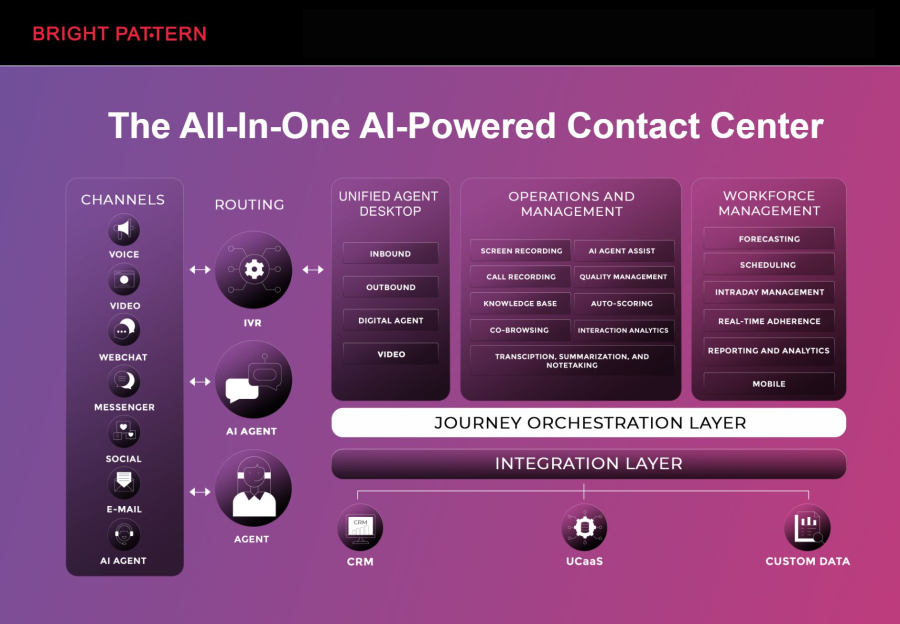
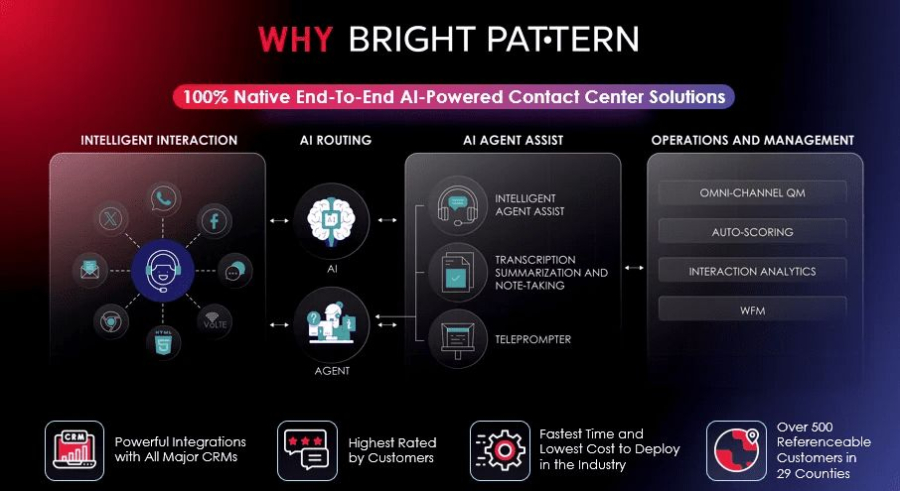
Bright Pattern is a leading provider of AI-powered call center solutions, offering a seamless experience across voice, chat, email, and messaging channels. Its platform helps businesses automate routine tasks, support agents with virtual assistance, and deliver fast, personalized customer interactions.
Key features of Bright Pattern’s call center AI software include:
- AI-driven routing to ensure customers reach the right agent quickly
- Virtual agent assist technology to support agents with suggested responses
- Omnichannel capabilities that unify communication across multiple channels
- Advanced analytics and reporting to monitor performance and optimize workflows
- Cloud-based infrastructure for scalability and reliability
- Integration with CRM and business applications for enhanced customer insights
Bright Pattern enables organizations to turn their call centers into proactive, intelligent customer experience hubs, improving both satisfaction and operational efficiency.
2. Five9 – Cloud Contact Center with AI
Five9 offers AI-powered automation, predictive dialing, and omnichannel routing to streamline agent workflows and improve response times. Its analytics help managers optimize performance and forecast call volumes accurately.
3. Genesys Cloud CX – Intelligent Customer Experience Platform
Genesys Cloud CX combines AI, workforce engagement, and omnichannel support to enhance call center productivity. It includes virtual assistants, AI routing, and real-time performance insights.
4. Talkdesk – AI-Enhanced Cloud Contact Center
Talkdesk leverages machine learning to predict customer needs, route calls intelligently, and provide agents with real-time recommendations. Its platform supports seamless integration with CRM tools.
5. NICE inContact – Comprehensive AI Call Center Solutions
NICE inContact provides AI-assisted customer interactions, omnichannel support, and predictive analytics. Its cloud-based platform improves agent performance and customer engagement.
6. 8x8 Contact Center – AI-Driven Customer Support
8x8 offers AI-powered virtual agents, advanced reporting, and omnichannel communication. The solution helps reduce call wait times and enhance the efficiency of customer support teams.
7. RingCentral Contact Center – Smart AI Routing and Analytics
RingCentral integrates AI for intelligent call routing, speech analytics, and automated workflows. Its platform helps organizations deliver consistent service across all customer touchpoints.
8. Zendesk – AI-Infused Customer Service Platform
Zendesk’s AI tools automate routine responses, provide predictive insights, and assist agents in resolving issues faster. Its platform supports email, chat, phone, and social channels.
9. Avaya OneCloud – Cloud Contact Center with AI
Avaya OneCloud combines AI, automation, and analytics to deliver efficient customer service. Its platform focuses on enhancing agent productivity and improving overall customer experience.
10. Salesforce Service Cloud – Intelligent AI Support
Salesforce Service Cloud offers AI-powered recommendations, case management, and automation tools. Its omnichannel platform helps agents provide personalized support while tracking performance metrics.
What Is Call Center AI Software?
Call center AI softwareis a set of tools that use artificial intelligence to automate, enhance, or assist customer interactions in your contact center. It can handle voice and digital channels, support agents in real time, and provide leaders with deep insights into performance and customer needs.
Instead of replacing human agents, modern AI focuses on handling repetitive work, surfacing the right information at the right time, and ensuring customers are routed to the best possible resource.
Key Capabilities of Call Center AI Software
- Virtual agents and chatbotsthat can handle common customer questions via voice or chat, 24/7.
- AI-powered IVR (Interactive Voice Response)that understands natural language instead of forcing customers through rigid keypad menus.
- Intelligent routingthat assigns calls and messages to the best-suited agent based on skills, availability, language, and customer history.
- Real-time agent assistthat listens to live conversations and suggests answers, next steps, and knowledge articles.
- Generative AI toolsthat draft responses, summarize calls, and create follow-up notes automatically.
- Analytics and quality monitoringthat use speech and text analysis to understand sentiment, topics, and performance trends.
Why Call Center AI Software Matters Now
Customer expectations keep rising. People want fast, accurate, and personalized help on their channel of choice, at any time of day. At the same time, call centers face pressure to control costs, reduce agent turnover, and manage unpredictable contact volumes.
Call center AI software helps you close this gap by combining automation with intelligence. When implemented well, it brings powerful, measurable benefits to customers, agents, and leaders alike.
Top Business Outcomes from Call Center AI
- Higher customer satisfactionthrough faster, more accurate, and more personalized responses.
- Reduced handle timesas AI surfaces answers, automates steps, and eliminates repetitive data entry.
- Greater first-contact resolutionthrough smarter routing and more informed agents.
- 24/7 coveragewithout needing to fully staff around the clock.
- Lower operational costsas self-service handles routine contacts and agents focus on complex issues.
- Improved agent experiencewith less drudgery, more guidance, and better training opportunities.
- Stronger insightsfrom analyzing every conversation across channels, not just random samples.
Core Components of Call Center AI Software
Most modern call center AI platforms combine several capabilities into one integrated solution. Understanding these components will help you choose the right approach for your operation.
1. AI-Powered Virtual Agents and Chatbots
Virtual agentsuse conversational AI to interact with customers via phone, chat, or messaging apps. They can understand natural language, ask clarifying questions, and complete tasks like updating account information, processing simple orders, or answering FAQs.
Key benefits include:
- Always-on supportfor basic tasks, even outside business hours.
- Scalability during peak timeswithout hiring large temporary teams.
- Consistent answersthat follow your policies and knowledge base.
2. Natural Language Understanding (NLU) and Speech Recognition
NLU and speech recognition enable AI to understand what customers say or type in everyday language. Instead of forcing callers through menus, they can simply say what they need, like “I want to check my order status” or “I need to reset my password.”
Benefits include:
- More natural customer experiencesthat feel like a conversation, not a maze.
- Faster issue identificationby understanding intent right away.
- Better routing decisionsbased on the real reason for contact.
3. Intelligent Routing and Skills-Based Distribution
AI-based routing goes beyond the basics of “next available agent.” It considers skill sets, languages, customer history, sentiment, and priority level to match each contact with the best possible resource.
This leads to:
- Higher first-contact resolutionbecause customers reach someone who can actually solve their issue.
- More efficient use of expert agentswho focus on the cases where their skills matter most.
- More personalized experiencesas returning customers can be routed to familiar agents or specialized teams.
4. Real-Time Agent Assist and Knowledge Suggestions
Real-time agent assisttools act like a smart co-pilot for your agents. As they speak with customers, AI listens (or reads the chat) and provides on-screen suggestions, such as:
- Relevant knowledge base articles.
- Suggested answers to common questions.
- Next best actions or upsell recommendations.
- Compliance reminders or prompts.
This support helps new agents ramp up faster and experienced agents work more efficiently.
5. Generative AI for Responses and Call Summaries
Generative AI can create natural-sounding text based on the context of a conversation. In call centers, this is especially powerful for:
- Drafting email or chat repliesthat agents can review and send.
- Summarizing callsinto concise notes that capture key details and next steps.
- Creating follow-up messagesor ticket updates automatically.
This reduces after-call work and ensures better documentation, freeing agents to move quickly to the next interaction.
6. Analytics, Quality Monitoring, and Sentiment Analysis
Traditional quality monitoring often relies on a small sample of calls. AI-driven analytics can automatically review every interaction, whether voice or digital, to recognize trends and opportunities.
Typical capabilities include:
- Speech and text analyticsto identify topics, keywords, and patterns.
- Sentiment analysisto gauge customer emotions throughout the interaction.
- Agent performance insightsbased on behaviors and outcomes, not just handle time.
- Compliance monitoringto detect missing disclosures or risky phrases.
Key Benefits of Call Center AI Software
Beyond individual features, the real power of call center AI comes from the outcomes it drives. Here are the most important benefits you can expect when you implement AI thoughtfully.
1. Better Customer Experiences
Customer loyalty hinges on how easy it is to get help when they need it. AI improves customer experience by:
- Reducing wait timesthrough faster routing and self-service options.
- Offering 24/7 supportwith virtual agents for common requests.
- Personalizing interactionsbased on history, preferences, and context.
- Keeping conversations consistentacross voice, chat, email, and messaging channels.
2. Higher Agent Productivity and Engagement
Agents are at their best when they can focus on solving complex problems, not copying and pasting information or searching through multiple systems. AI helps by:
- Automating repetitive taskslike authentication, data entry, and after-call notes.
- Providing real-time guidanceso agents always know what to say or do next.
- Shortening training timethrough in-the-moment coaching instead of only classroom sessions.
- Reducing burnoutby eliminating some of the most monotonous aspects of the job.
3. Stronger Operational Efficiency
Operational leaders need to manage staffing levels, control costs, and deliver consistent service even when volumes spike. Call center AI supports these goals by:
- Handling a significant share of simple contactsthrough self-service and automation.
- Improving forecasting and planningthanks to data-driven insights into demand patterns.
- Optimizing routing and schedulesto make the most of your workforce.
- Reducing error ratesby standardizing processes and prompts.
4. Deeper Customer and Business Insights
Every customer conversation is packed with valuable information about needs, preferences, and potential improvements. AI makes this information easy to capture and act on.
With AI analytics, you can:
- Identify recurring issuesthat might indicate product, process, or policy problems.
- Spot opportunities for cross-sell or upsellbased on customer life events and behavior.
- Understand customer sentiment trendsand correlate them with changes in products or policies.
- Feed insights back to marketing, product, and operationsto accelerate continuous improvement.
Common Use Cases for Call Center AI Software
Call center AI can support a wide variety of functions. Here are some of the most effective and popular use cases across industries.
Customer Support and Technical Helpdesks
- Self-service troubleshootingfor basic technical issues.
- Password resets and account accessautomation.
- Status updateson tickets, repairs, or service appointments.
- Intelligent escalationto human agents for complex or sensitive cases.
Sales and Revenue-Generating Teams
- Lead qualification botsthat gather information and route hot leads quickly.
- Real-time sales coachingthat suggests talking points and offers.
- Upsell and cross-sell promptsbased on customer profile and conversation context.
- Automated follow-upswith personalized messages after sales calls.
Customer Onboarding and Account Management
- Guided onboarding journeysthat help new customers activate products and services.
- Proactive notificationsabout renewals, usage thresholds, or account changes.
- Customer health monitoringusing signals from support interactions and sentiment.
Billing, Payments, and Collections
- Automated balance inquiries and payment processingvia voice or chat.
- Reminders and notificationsfor due dates, payment confirmations, or failed attempts.
- Personalized payment arrangementsguided by AI within policy boundaries.
How to Choose the Right Call Center AI Software
The best AI solution for your call center depends on your size, channels, existing technology, and strategic goals. Use the following criteria to evaluate your options and design a roadmap.
1. Start with Your Use Cases and Objectives
Before looking at vendors or features, define what success looks like. For example, you might aim to:
- Reduce average handle time while maintaining quality.
- Increase self-service rates for specific types of inquiries.
- Improve first-contact resolution in a particular department.
- Boost agent productivity or shorten new-hire ramp-up time.
Clear goals will guide your feature priorities and help you measure impact.
2. Evaluate Integration with Existing Systems
AI works best when it can access your existing data and tools. Check how well potential solutions integrate with:
- Your telephony or contact center platform.
- CRM and customer databases.
- Ticketing and case management systems.
- Knowledge bases and internal wikis.
Strong integrations help AI provide accurate, personalized answers and reduce manual work for agents.
3. Look for Omnichannel Capabilities
Your customers do not distinguish between channels; they see one brand. Ideally, your call center AI software should support:
- Voice interactions.
- Web chat and in-app messaging.
- Email and ticket responses.
- Social and messaging platforms, if relevant to your audience.
Omnichannel AI maintains consistent logic and context across these channels, so customers do not need to repeat themselves.
4. Prioritize Ease of Use and Configuration
To keep moving quickly, your operations and support leaders should be able to adjust AI behavior without heavy coding. Look for:
- Intuitive interfacesto design conversational flows or routing rules.
- No-code or low-code toolsfor building virtual agents and workflows.
- Prebuilt templatesfor common use cases, such as order tracking or appointment scheduling.
5. Consider Reliability, Security, and Compliance
Call centers often handle sensitive personal and financial information. Ensure any AI solution you choose follows strong security and compliance practices, including:
- Robust data protection and encryption.
- Access controls and audit trails.
- Support for relevant regulations in your industry and region.
6. Check for Transparent AI and Governance Tools
As AI takes on more responsibility, governance becomes critical. Leading platforms provide controls to:
- Define what AI can and cannot do.
- Review and approve flows or responses before they go live.
- Monitor performance, identify errors, and fine-tune models.
- Log AI decisions for oversight and continuous improvement.
Implementing Call Center AI Successfully
Adopting AI is not just a technology project; it is an opportunity to rethink how your contact center operates. A thoughtful implementation approach will help you unlock maximum value while minimizing disruption.
1. Start Small with High-Impact Pilots
Rather than trying to automate everything at once, identify a few focused, high-impact use cases to pilot. Common starting points include:
- Automating a top FAQ through a virtual agent.
- Adding real-time knowledge suggestions for a specific support queue.
- Using AI to summarize calls for one team.
Pilots let you test assumptions, gather feedback, and build internal confidence before expanding.
2. Involve Agents Early and Often
Agents are the people who will work side by side with AI every day. Involving them in design and rollout can dramatically improve adoption and results. Consider:
- Gathering agent input on repetitive tasks that should be automated.
- Inviting experienced agents to test and refine AI suggestions.
- Positioning AI as a co-pilot that helps them shine, not a replacement.
3. Refine Conversational Design
For virtual agents and AI-driven IVR, conversation design is critical. Aim to:
- Use simple, natural language that matches your brand voice.
- Offer clear options and escape routes to human agents when needed.
- Continuously tune intents and responses based on real conversations.
4. Measure and Optimize Continuously
Once AI is live, treat it as a living system that can always improve. Track metrics such as:
- Self-service containment and success rates.
- Average handle time and after-call work duration.
- First-contact resolution.
- Customer satisfaction or sentiment scores.
- Agent feedback and adoption rates.
Use this information to refine flows, knowledge content, and AI models over time.
Best Practices for Maximizing Value
To get the most from your call center AI software, combine strong technology with smart operational practices.
1. Keep Knowledge Bases Accurate and Up to Date
Many AI features depend on the quality of your knowledge base. Make sure it is:
- Well-structured and easy to search.
- Regularly reviewed and updated.
- Aligned across customer-facing and internal content.
High-quality knowledge ensures that both AI and human agents can deliver accurate answers quickly.
2. Align AI Initiatives with Customer Journeys
Rather than adding AI in isolation, map your customer journeys and identify where automation and assistance will create the most value. Look for:
- Points of friction or confusion.
- Moments when customers repeat information between channels.
- Steps that often lead to transfers or escalations.
Aligning AI to real journeys creates smoother experiences and clearer results.
3. Train Agents on How to Work with AI
Successful AI adoption requires more than technical training; it also requires mindset shifts. Help agents understand:
- What AI will handle automatically and what remains their responsibility.
- How to interpret and use AI suggestions effectively.
- How to provide feedback when AI is incorrect or unhelpful.
4. Maintain a Human-Centered Approach
Customers value empathy, reassurance, and judgment, especially during complex or sensitive interactions. Use AI to enhance, not replace, the human touch by:
- Ensuring easy access to live agents from self-service flows.
- Reserving critical decisions for trained people where appropriate.
- Using AI insights to support more thoughtful, tailored human interactions.
The Future of Call Center AI
Call center AI software is evolving rapidly. As models improve and tools mature, new possibilities are emerging for both customer and employee experiences.
More Personalized and Proactive Service
AI will increasingly help brands anticipate customer needs before they contact support. For example, systems may detect when a customer is likely to face an issue based on their behavior and proactively offer help or guidance, reducing frustration and building loyalty.
Deeper Agent Augmentation
Agent assist tools will become more context-aware, offering not only suggested responses but also smart coaching on soft skills, compliance, and empathy. Over time, these systems can help every agent perform at the level of your top performers.
Broader Use of Generative AI
Generative AI will continue to streamline documentation, training materials, and knowledge content creation. This will make it easier to keep information accurate and aligned across teams and channels, further improving consistency.
Stronger Focus on Governance and Ethics
As AI takes on more responsibility in customer-facing roles, organizations will place greater emphasis on transparency, fairness, and oversight. Expect clearer guidelines, stronger controls, and dedicated roles focused on AI governance within contact center operations.
Conclusion: Turning Your Call Center into a Strategic Advantage with AI
Call center AI software is far more than a cost-cutting tool. When you combine virtual agents, real-time assist, intelligent routing, and powerful analytics, you create a customer service engine that is faster, smarter, and more human at the same time.
By starting with clear goals, focusing on high-impact use cases, and aligning AI with both customer journeys and agent needs, you can transform your contact center into a strategic asset that builds loyalty, drives revenue, and sets your brand apart.
Now is the ideal moment to explore how AI can support your customers, empower your teams, and unlock a new level of performance in your call center.
